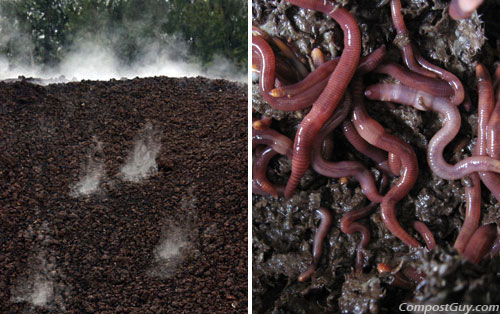
What’s the difference and which one is better?
As I mentioned in a recent article, I tend to lump hot (thermophilic) composting, vermicomposting, and (small-scale) ‘backyard’ composting together under the general term ‘composting’ (even though it is a term often referring to the thermophilic process). This of course is not to imply that they are all the same thing! They are in fact quite different.
In this article I will focus specifically on the difference between thermophilic composting and vermicomposting (composting with worms).
Let’s start by looking at the similarities.
Both of these processes involves the bio-oxidation of organic wastes - typically with human assistance - resulting in a rich, humus-like material. As ‘bio-oxidation’ implies, they both require oxygen for optimal performance.
The ‘carbon to nitrogen ratio’ (C:N ratio) is important for both, and plays an important role in determining the rate at which decomposition occurs - although it is definitely more important for hot composting.
That is essentially where the similarities end. Let’s now look at each process in more detail.
Hot Composting
As the name implies, thermophilic composting involves an important heating stage. This heat is caused by microbial metabolism and is dependent on the size of the heap, C:N ratio of the materials, moisture content and aeration. During this heating stage, temperatures will ideally be in the 140 F (60 C) range, but will often be higher or lower.
This type of composting typically follows the ‘batch’ model - that is to say all the materials for the heap are piled up at one time and no more is added. In order to establish a sustained heating phase a ‘critical mass’ of materials is required. Assuming adequate C:N ratio, a pile needs to be at least 1 cubic meter in size (somewhat larger is probably better though).
Hot composting can be achieved when materials in the pile have a C:N of between 20:1 and 40:1, but ideally it should be between 25:1 and 30:1.
Pros
1) Enables processing of larger quantities of materials in a smaller area
2) Can proceed relatively quickly under ideal conditions
3) Can kill weed seeds and pathogens
4) On a large scale can proceed easily in cold weather
Cons
1) Can be labor-intensive (piling wastes, turning pile etc) and require more attention
2) Heat can kill off many beneficial microbes
3) May require some stock-piling until sufficient materials available for ‘batch’
4) Heating can lead to considerable nitrogen loss
Vermicomposting
As mentioned, vermicomposting is somewhat similar to hot composting in that it involves the breakdown of organic wastes, but one of the major differences of course is that it involves the joint action of earthworms and microorganisms (whereas the other process relies solely on microbes). I should mention that the term ‘earthworm’ is actually somewhat misleading, since the worms needed for worm composting are specialized for life in rich organic materials (not soil).
Worm composting is also a much cooler process - working best at 59-86 F (15-30 C). It typically follows the ‘continuous’ composting model - that is to say materials are added continuously (usually in smaller amounts).
Again, C:N ratio while fairly important, is not quite so critical for optimal performance. Materials with high C:N ratios (such as paper sludge) have been processed quite readily via vermicomposting.
Pros
1) Tends to be somewhat less labor-intensive - no turning/aerating necessary (worm activity helps to mix, fragment and aerate materials)
2) Cooler temperatures help to conserve nitrogen
3) Higher moisture contents not an issue (and actually preferred)
4) Materials can be constantly added (no need to stock pile in preparation for next ‘batch’)
5) Size of system unimportant - ideally suited for both indoors and outdoors
6) Considerable academic evidence to indicate that vermicomposts have beneficial properties not found in hot composts
7) Under ideal conditions, wastes can be processed very quickly
Cons
1) Won’t kill seeds (and although there is a fair amount of evidence to indicate pathogen destruction, more research is required)
2) More space required to process similar amounts as hot composting - need to be careful with amount added (since excess heat will kill worms)
3) Outdoor systems much more limited by cold weather
4) Worms need to be separated from compost
5) Worms (although quite resilient) do require some attention and proper care.
As far as which of these two processes is “better”, it totally depends on the situation. I personally think an optimal approach (when possible) is to combine BOTH of these two methods. By ‘pre-composting’ then vermicomposting waste materials you can get the best of both worlds. Pathogen and weed seed destruction of hot composting (without too much nitrogen loss), followed by fast processing by worms and production of high quality vermicompost.
Needless to say, I’ll be talking about both these processes (along with other related composting methods) in much greater detail in coming weeks and months, so do stay tuned!
Technorati Tags: compost, composting, thermophilic, compost bin, worm composting, vermicomposting, red worms, red wigglers, organic wastes
[ratings]
Written by Compost Guy on September 28th, 2007 with no comments.
Read more articles on Composting and Worm Composting.
I’ve written a fair amount about Patti “The Garden Girl” Moreno on the EcoSherpa blog, but she definitely deserves some mention here as well. Patti has been a real inspiration ever since she burst onto the green scene with her ‘Urban Sustainable Living’ videos last year. She seemed to vanish for awhile (I think she was busy with her film production company), but I was very pleased to see her resurface quite recently - this time with some great news to share.
Apparently she has partnered with FarmersAlmanac.com and will be creating lots of new videos in her series!
In her latest newsletter she provided a sneak peak of her new website (looks like it’s going to be very nicely done!) and also shared some links for a few of her videos. I’ve included them here.
Who is Garden Girl?
What is Urban Sustainable Living?
Raised Beds in the City and Hoophouses
Kifo the Garden Gnome
It sounds as though there will be plenty more videos on the way, along with a completely revamped website! I will continue to share new videos and updates here on the blog.
Technorati Tags: patti moreno, garden girl, sustainainable living, composting, raised beds, gardening, urban farming, farmers almanac, homesteading
[ratings]
Written by Compost Guy on September 25th, 2007 with no comments.
Read more articles on Sustainable Living and Urban Farming.
If a tree falls in the woods but no one is there to hear it, does it make a sound?
This is the riddle that comes to mind as I contemplate the definition of composting. If a heap of leaves rots in the woods but no one is there to turn it, does it really compost?
Some people seem to equate the term composting with any sort of decomposition of (solid) organic wastes - regardless of whether or not there is any human facilitation. Others insist that the human element is in fact what makes composting composting!
I personally tend to lean towards the latter. As such, here is how I would define it:
Composting is the aerobic bio-degradation of organic materials under controlled conditions, resulting in a rich humus-like material.
Let’s now talk about the key parts of that definition. Firstly, composting involves ‘aerobic’ processes, which means simply that it requires oxygen to proceed properly. While ‘anaerobic’ (without oxygen) regions can (and will) develop in a compost pile/bin, our aim is to keep the system as aerated as possible.
‘Bio-degradation’ simply means the breakdown of materials by living organisms (primarily microbes). ‘Organic materials’ are all those materials that were once living themselves (eg leaves, grass clippings etc) or are the waste products of living organisms (eg manure). ‘Controlled conditions’ simply means that it doesn’t happen by accident.
There needs to be some human intention and assistance involved. Finally, ‘humus’ (not to be confused with hummus - haha) is a dark, stabilized organic material that is essentially at, or at least near, the end of the road as far as decomposition goes. It plays a very important role in overall soil fertility (rich, healthy soils tend to have a higher proportion of humus).
Of course, even with clear definitions there can still be plenty of gray area!
When a farmer dumps a big pile of manure out behind his barn without the specific intention of composting it, yet it still heats up and stabilizes over time, is that composting?
Speaking of ‘heating up’, I should also mention that some people (such as composting professionals) would likely insist that even my definition of composting is incomplete since I made no mention of a heating phase.
The term ‘composting’ is in fact frequently used as a synonym for ‘hot composting’ (a.k.a ‘thermophilic composting’), but for our purposes here I’m going to give the term a broader scope. This way we can include worm composting (a.k.a vermicomposting’) and small-scale (wormless) backyard composting, both of which are much cooler processes.
However you define it, one thing is for sure - composting is an fantastic way to convert ‘wastes’ into a highly valuable resource!
Technorati Tags: compost, composting, humus, soil, waste, organic, compost bin, vermicomposting
[ratings]
Written by Compost Guy on September 24th, 2007 with no comments.
Read more articles on Composting.
Welcome to the first official post here on the Compost Guy Blog!
I wasn’t sure how I was going to kick things off. I tend to think about these sorts of things way too much, and and this was certainly no exception!
I decided in the end that the best approach was to simply write about a topic close to my heart - vermicomposting! I already have another site dedicated to the topic, but that certainly won’t stop me from providing plenty of wormy commentary and information over here as well!
My first inkling of an interest in worm composting actually can be traced back to my days as an avid aquarium hobbyist (something I’d like to get back to once I have a little more space!). Specifically, I was looking for various live foods I could easily raise at home, and worms seemed to offer great promise.
Like many other worm farming newbies, I naturally assumed I could dig up a bunch of worms from the garden put them in a bucket of soil with a little “food” and sit back while they bred like crazy! Of course it was only a matter of time before I ended up with a bucket of dead worms and an increased pessimism about the viability of home ‘worm farming’.
I finally clued in to the fact that I using the wrong kind of worms! What’s interesting is the fact that I had actually encountered a massive supply of red wigglers (composting worms) when I was working at a horse stable a number of years before. Out behind the barn there was a giant pile of old horse manure and it was absolutely jammed full of them.
I took a bucket full of them home with me, thinking I could start my own bait business. I even had the sense to dump them into a compost pile (a very dry, pathetic compost pile I might add), but it was hardly the ideal environment for them so they died off or at least vacated the area.
Everything finally came together for me a number of years later while working for an environmental consulting firm. One day I caught wind of the fact that a fellow co-worker kept a worm bin under her desk. I decided I have to see it for myself.
It was love at first sight!
Luckily my co-worker appreciated my sincere enthusiasm and offered to send me home with a decent number of red wigglers. I haven’t looked back since!
Well, I think that’s enough of a trip down memory lane for one post! You can expect to hear a lot more about worm composting here at Compost Guy (along with a wide variety of other topics), so stay tuned!
If you are a real worm composting keener, be sure to check out RedWormComposting.com
[ratings]
Technorati Tags: worm composting, vermicomposting, worm bin, red worms, red wigglers, worm farming, compost bin, compost, worm castings
Written by Compost Guy on September 1st, 2007 with no comments.
Read more articles on Worm Composting.